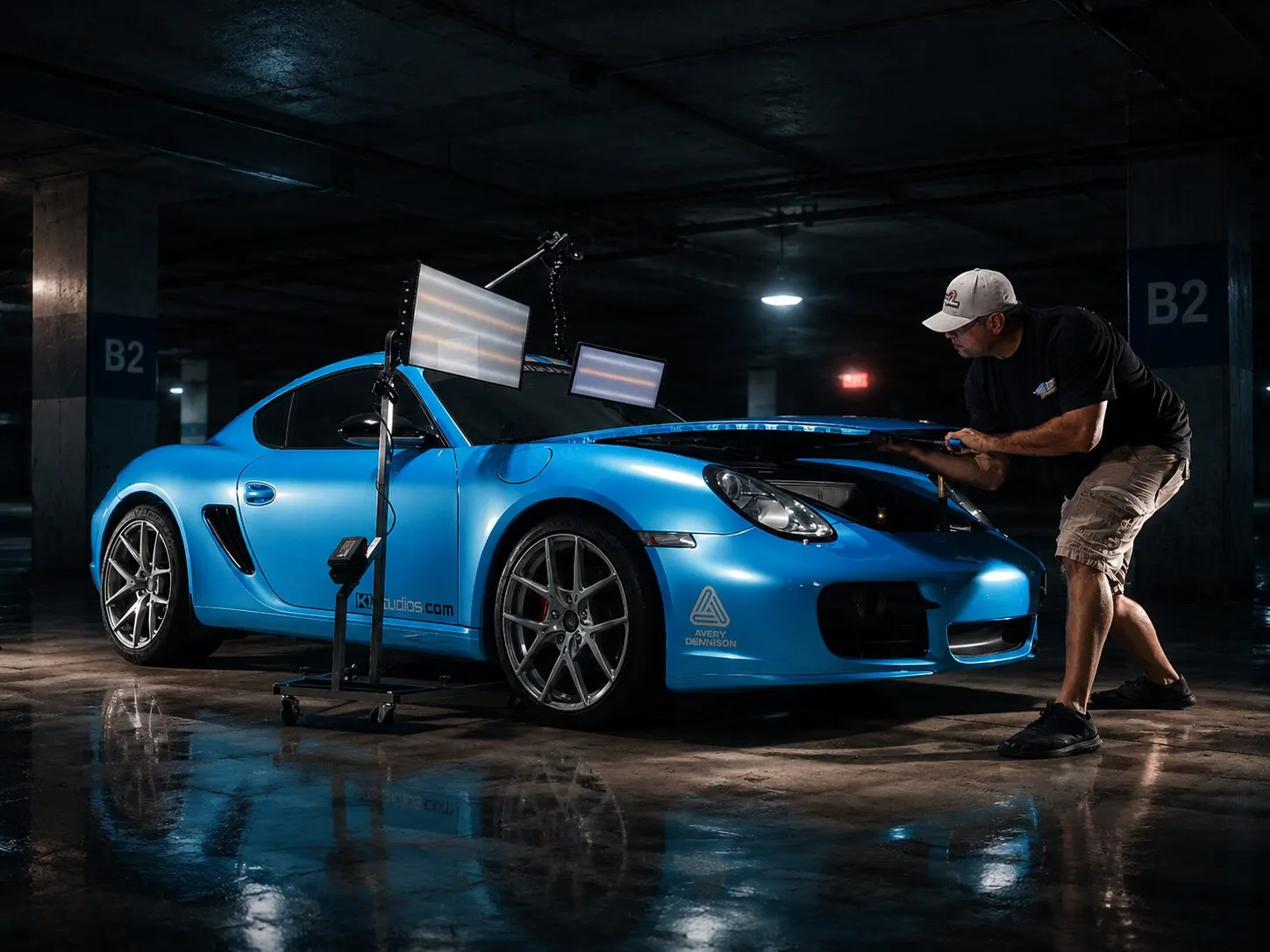
A real glue pull in our shop. Same idea as the kit, different read, different result.
Sometimes. That is the honest answer, and it is more honest than the product page you just read. A suction cup or a glue kit can move a shallow, saucer-shaped dent sitting in the middle of a flat panel with the paint intact. Outside that narrow lane, the odds fall off fast, and the failed attempts land in our shop every week.
I have been repairing dents since 1991, and glue pulling is part of my own toolbox. So this is not a technician sneering at the tool. It is a technician telling you what the tool can do in a driveway, what it does to paint when it goes wrong, and how to know which side of that line your dent is on before you spend anything. It is the companion to our dry ice myth breakdown, because the pullers are what people reach for after the temperature tricks fail.
| Repair | Typical price | After a DIY pull attempt |
|---|---|---|
| Door ding | $197 to $250 | Adhesive high spots have to come down first, which adds time |
| Medium dent | $275 to $500 | Metal worked past its limit takes longer to read and settle |
| Crease or body line | $225 to $600 | Pullers rarely touch these, so usually no harm done, just no progress |
| Cracked clear coat | Body shop territory | No longer paintless. Filler, repaint, and a line on the history report |
Do dent pullers actually work on car dents?
Rarely to a finished panel. Even the shallowest dent on a flat panel leaves a high spot behind the pull, and a high spot is easier to see from a distance than the dent you started with.
Here is what every puller has in common, from the $10 suction cup to the $60 glue kit. It applies force from the outside, in one direction, at one spot, with no way to see what the metal is doing while you pull. Glue pulling looks easy, and on a small, light, shallow dent it technically is. But there is rarely a time a puller or a glue system pulls a dent flat. What it actually does, even on the shallowest dent in a flat panel, is trade the low spot for a high spot.
And that trade runs the wrong direction. A shallow low spot hides. The smallest high spot shows from across a parking lot, because light breaks over a peak in a way it never does over a dish. Then comes the second mistake. The kit owner sees the new bump and tries to tap it down blind, without a reflection to read, and the panel gets worse with every tap. This is why the read is the repair. Not the pull.
Myke has watched the results walk through the door for years. In his words, "I have seen many people come in with a wavy or lumpy looking dent because they used some sort of Amazon or Temu kit, and it made the repair worse." Wavy and lumpy is exactly what an unread pull produces. The low spot improves, the stretch and the tension stay, and the tab or the cup raises new high spots the puller has no way to see.
Why can the kit not see them? The light. "To make a dent successfully go away, you have to use a specific light. Without the light, you will not be able to read the high and low spots. It is a complete guess." That is the whole subject in three sentences. Sunlight scatters and hides dents, which is why damage seems to appear the first time you pull into a garage. The dent you improved in the driveway is usually still there. You just moved to lighting that cannot show it to you.
Do suction cup dent pullers work?
Only on large, shallow, gently curved dents where the cup can seal, and even then the panel usually pops partway back and stops.
A suction cup needs two things the average dent refuses to give it. A surface smooth enough to hold a seal, and a dent shallow enough that a straight outward pull can release it. A crease breaks the seal. A body line breaks the seal. A sharp impact point sits below where the cup can reach.
The one dent suction has a real relationship with is the big soft dent, the kind a knee or a shopping cart leaves in the middle of a door skin. Those hold tension like the bottom of an oil can, and a pull can pop the panel back with a bang. Even there, the pop is not the finish. The panel still needs to be read under a reflection, because the release almost always leaves highs the eye cannot find on its own.
The catch is the word partway. Most oil-can pops release the middle and leave the rim, a soft ring of low that shows in every reflection down the side of the car. The panel went from dented to wavy. Better, and not right, and the difference is exactly what a trained eye is for. What counts as that kind of dent is covered in how big a dent can be for PDR.
The line board read. The reflection bends where the panel still holds damage the eye cannot find.
Do glue dent puller kits damage your paint?
They can. The kit glue grips harder than aged or repainted finishes can hold, and a bad pull lifts clear coat or leaves a crowned high spot that costs more to fix than the original dent.
The glue kit is the more capable tool and the more dangerous one, for the same reason. It bonds to the paint itself. Here are the real odds from our own bays. On factory paint, there is roughly a 10 percent chance a pull lifts finish, and it varies by manufacturer in ways you cannot predict from the driveway. On a repainted panel, the odds flip against you, 80 percent or more. There is no undo for either. The moment clear coat comes up, the repair stops being paintless, and the only fix is a paint shop. Dent Time runs its own paint division for exactly this, because enough people arrive having pulled paint on their own vehicle.
The second failure is subtler. Kits ship with a bridge or a slide hammer and no way to meter the pull, so first-timers pull big. The tab brings the metal past level and leaves a crown, a raised bump where the dent used to be. On aluminum panels it is worse, because aluminum is stiffer, moves in smaller amounts, and shows every oversized pull as a hard little peak. We wrote about what those failed repairs look like in how to spot bad paintless dent repair.
A crown is not a cosmetic footnote. High metal has to be tapped back down with control, and knocking down someone else’s crown through cracked-adhesive residue is slower than working a clean dent. That is why a panel that has been through a kit weekend often quotes higher than the same dent untouched.
One more thing, because people reach for the touch-up pen next. If a pull takes paint and you dab touch-up over it, "it is going to look like paint on top of paint, just as if you applied touch-up where it does not even belong on the vehicle." That is as good as it gets. The honest options are a proper repaint or living with it.
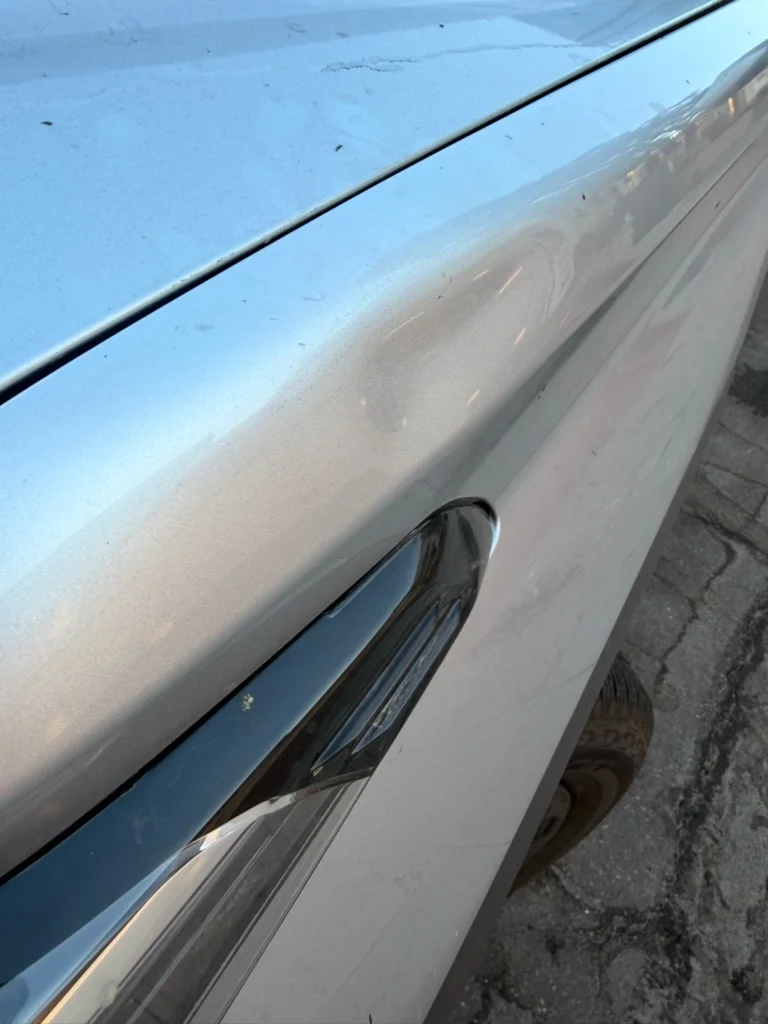
A real one. The dent exactly as the owner first sent it to us. A clean body line dent and a straightforward PDR candidate.
Why did the dent come back after I pulled it?
Because the pull released the surface shape without releasing the tension underneath, so the panel walked back toward the dent over the following days.
This is the most common text we get from kit owners. It looked fixed, and two days later the shadow was back. The explanation is pressure. Metal remembers the shape it was pushed into, and the ring of stress around a dent keeps voting for the dented shape until somebody deals with it directly. An unread pull usually makes that worse, not better. In Myke’s words, kit attempts cause "more trapped pressure than there was initially," so the panel has more reasons to walk back, not fewer.
A real repair releases that tension on purpose. Small pushes or pulls to move the low metal, then taps on the high metal around it, working the stress out of the panel a little at a time. Skip the taps and the release, and whatever the cup or the tab gained is on borrowed time. The panel is not broken. It is just still holding the argument.
Here is what that looks like in real life, on the same fender from the photo above. After sending us that picture, the owner decided to try it himself first, a glue puller, and then a screwdriver. The photo below is what arrived at our shop, under our line board. Every bend in those stripes is a high spot or a wave the attempt left behind. The dent was still there too. It had simply gained company.
If your dent came partly back after a pull, nothing is ruined. It usually means the dent was never fully out. Send photos and we will tell you what is actually left in the panel.
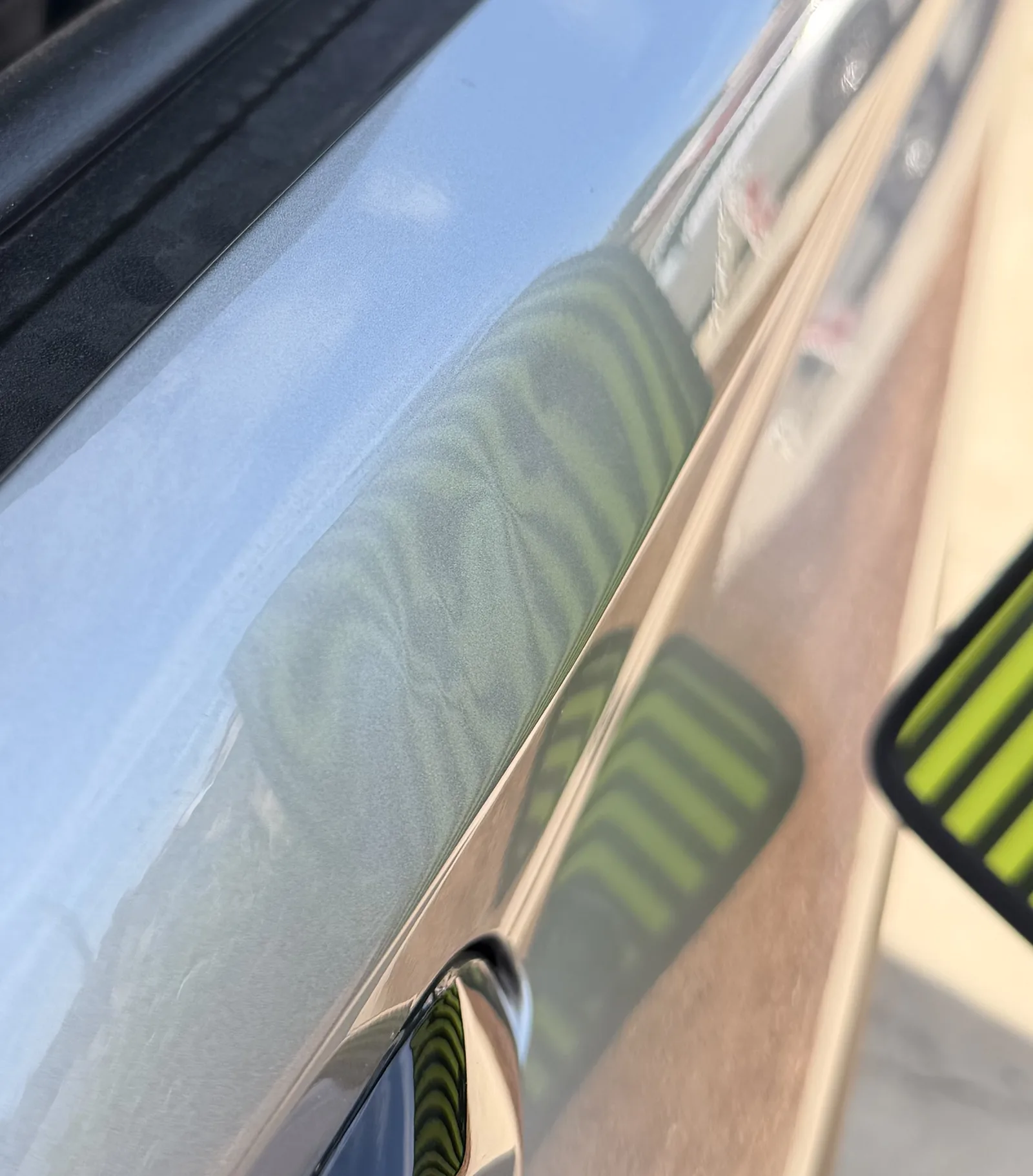
The same fender when it reached us, under the line board. Glue puller, then a screwdriver. Every bent stripe is metal the attempt moved the wrong way.
Is glue pulling a real professional technique?
Yes. Professional glue pulling is a core PDR method, and the difference from the kit is not the glue, it is the read between every pull.
Here is the part that surprises people. The kit you bought is a copy of a legitimate professional tool. We glue pull panels every week, usually where there is no clean access behind the metal. The adhesive is not the difference. The sequence is.
A professional pull starts under a line board that shows exactly where the low metal sits and how far it needs to travel. The tab size is matched to the dent. The pull is metered, small, and immediately checked. High spots get tapped down before the next pull. Pull, read, tap, read. The tool spends thirty seconds gripping the panel and the eye spends the rest of the time deciding what the next thirty seconds should do.
The kit gives you the grip with none of the read. That is why the same physics produces a finished panel in one setting and a crowned, half-returned dent in the other. It was never about the tool. It is about seeing what the pull just did before doing it again. Watch the correct sequence below, from Myke’s own channel, and notice how much of the video is reading rather than pulling.
The correct glue pull process, from Myke’s channel. The tab, the metered pull, and the read between every pull.
Should you try a dent puller on your own car?
Our recommendation is no, including the name-brand kits, because a consumer is not trained to read a reflection, tap down, or push with controlled pressure. If different or worse is acceptable to you, it is your car and the decision stays yours.
Myke used to leave room for the careful hobbyist. Not anymore, and the reasoning is worth hearing straight. "I recommend they do not even try it themselves. It is always likely it is going to cost them way more money. And if they are good with different or worse, then go ahead." The tool is not the problem. The three skills the tool assumes are the problem: reading a reflection, tapping down, and pushing with controlled pressure. No kit ships with any of them.
His comparison is the one that sticks. "It would be like asking a plastic surgeon if you could borrow a scalpel so you can work on your own nose." The scalpel is not what makes the surgeon, and the puller is not what makes the repair. The read is. That is why the same glue tab finishes a panel in our bay and leaves a wavy door in a driveway.
And for the people who are seriously curious rather than just hoping to save a couple hundred dollars, there is a real path. Myke has trained PDR technicians worldwide, and his online courses at denttrainer.com teach the actual skills, the light, the read, the controlled push. Learning the trade is a real option. Guessing at your own door with a $60 kit is not the same thing. If the dent just needs to be gone, a door ding repair runs $197 to $250 and is usually done within the hour.
What does a failed pull actually cost you?
Best case, nothing but the kit. Common case, a longer and costlier repair than the original dent. Worst case, cracked clear coat that turns a $250 paintless job into a body shop repaint.
Run the honest math before the weekend experiment. The dents that pullers target are our least expensive repairs, $197 to $250 for a ding, $275 to $500 for a medium dent. The kit is $40 to $80. So the bet saves a couple hundred dollars when it wins completely, and it rarely wins completely.
When it half-wins, you pay twice. The kit, and then a repair that takes much longer than the original dent would have, because the attempt trapped more pressure in the panel than the impact did. Our team has to reset the panel first, knocking down every high spot and wave the kit raised, before the actual dent work can start. In the worst stretch cases, metal pulled too high or pushed too low can jeopardize the strength of the panel itself. When the attempt loses outright, the clear coat cracks or the glue lifts finish, and the conversation changes from paintless repair to paint. Days without the car, and a repaint on the vehicle history that follows it to resale. The five hundred dollar problem became a fifteen hundred dollar one in a single pull.
We fix DIY attempts every week and we are glad to. The fender in the photos above ended the way most of them do. Our technician reset the waves the glue puller and the screwdriver left, worked the original dent, and handed it back with the reflection running straight, below. Just know the order of operations that protects your money. Photos first, verdict second. Most people run it in reverse. Why the same dent can carry two different prices is laid out in why PDR cost varies.
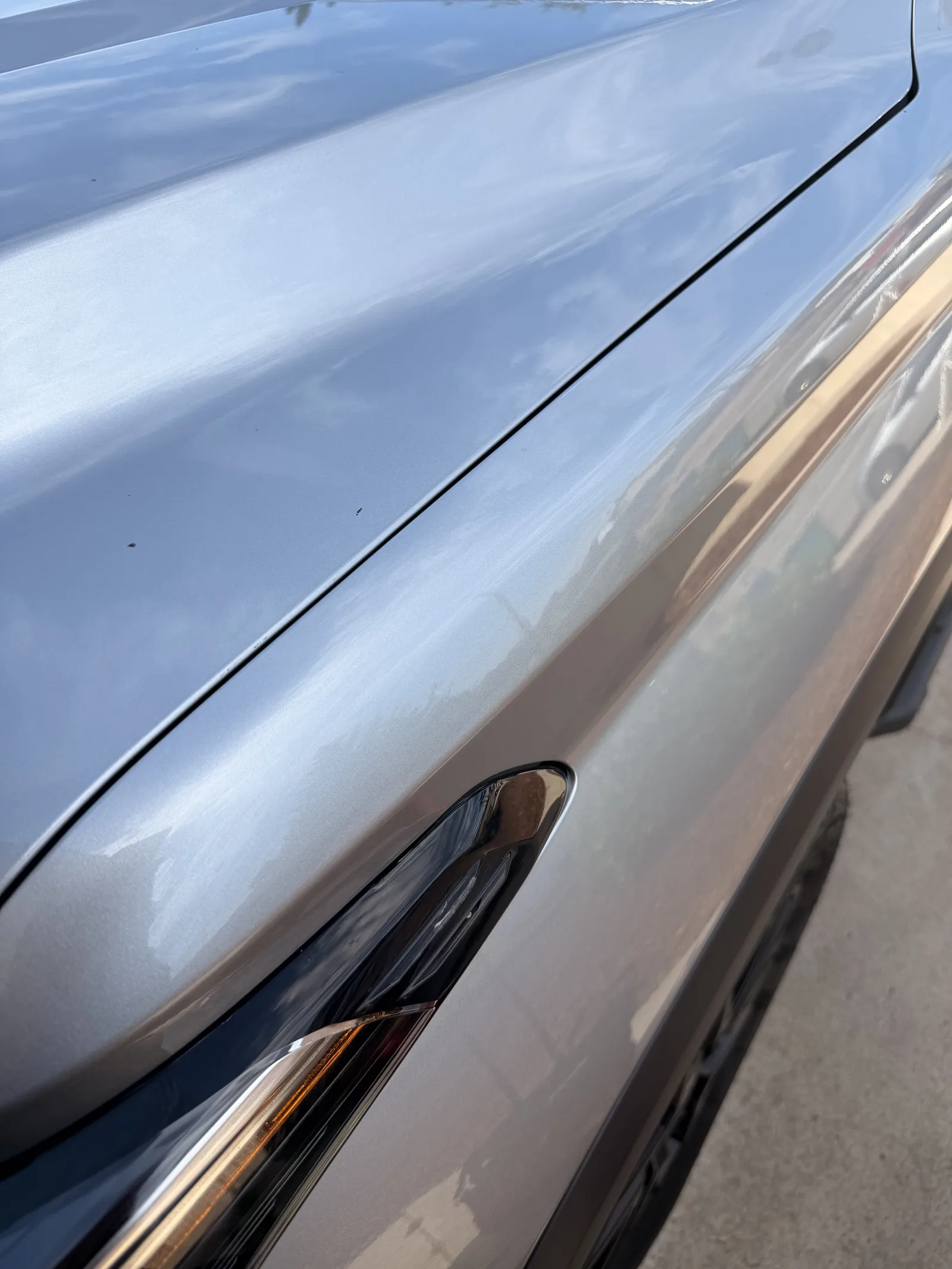
The finish. The attempt reset, the dent repaired, the reflection running straight.
Questions, Answered.
Do dent pullers work on car doors?
On the flat middle of a door skin, sometimes. Near the door’s edges, its body line, or its character crease, almost never, because the cup cannot seal there and a glue pull fights metal that is braced by the fold. Door dings that sit on or near a line need the metal worked from behind.
Do dent pullers work on aluminum panels?
Rarely, and the failures are uglier. Aluminum is stiffer than steel, moves in smaller increments, and shows every over-pull as a hard raised peak. Many hoods and doors on Teslas, Fords, and European cars are aluminum, and those panels deserve a technician who works the metal in tighter, more deliberate amounts.
Do dent pullers work on bumpers?
Bumper covers are plastic, so pullers are the wrong idea entirely. Plastic responds to controlled heat and pressure from behind, which is a real technique and a different one. Metal bumpers on trucks are another matter and usually a professional pull. Our bumper repair page covers what actually works on plastic.
Can a dent puller fix a crease?
No. A crease is a line of stretched, locked metal, and a single-point pull cannot release it. Creases are among the hardest repairs in PDR and the clearest case for skipping the kit, which we cover in whether PDR can fix sharp creases.
Will a dent pop out on its own?
Almost never on metal. Metal holds the shape it was pushed into until the tension is released by hand. A shallow flex in a plastic bumper cover can relax on a hot day, which is where that legend comes from. If your dent is in painted metal, it is waiting for a technician, not for summer.
How much does it cost to remove a dent without a kit?
At Dent Time, door dings run $197 to $250, medium dents $275 to $500, and creases $225 to $600, with the factory paint untouched and nothing added to the vehicle history. Most repairs finish the same day, many within an hour or two.
Can a dent puller pull off paint or clear coat?
It can. On factory paint the chance is roughly 10 percent and varies by manufacturer. On a repainted panel it jumps to 80 percent or more. Once paint lifts, the only real fix is a repaint, and touch-up over the spot reads as paint on top of paint. Dent Time has its own paint division for exactly these cases.
I already used a puller and it looks worse. Can it still be repaired?
Usually, yes. We repair kit attempts every week, wavy panels and all. The team resets the panel by knocking down the high spots the pull raised, then works the original dent. If the clear coat cracked, paint becomes part of the plan and we will say so straight. Text photos to 858-408-6200 and a technician will tell you exactly where the panel stands, no charge and no lecture.