
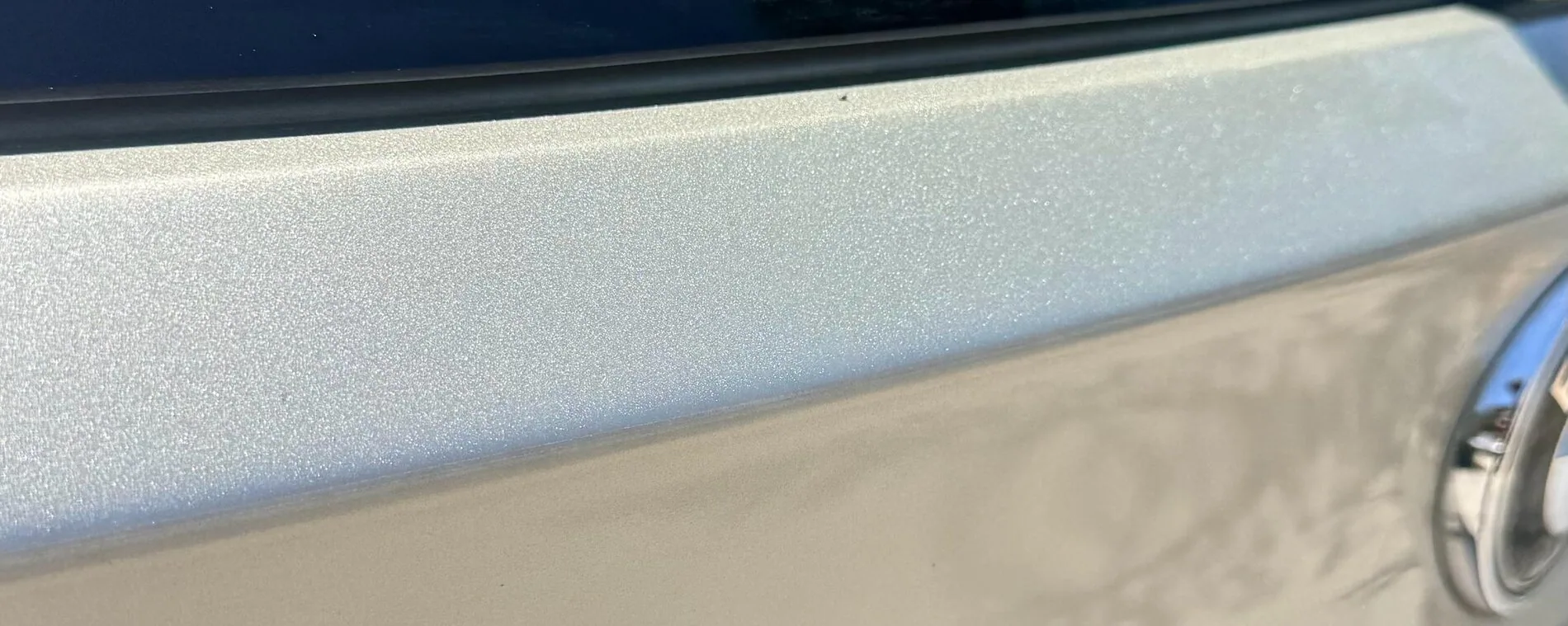
A crease is a line, not a point. That line is where the metal went hard.
A sharp crease can be repaired with paintless dent repair and no repainting, as long as the paint has not cracked and the back of the panel can be reached. That is the short answer. The longer answer is the one worth your time, because a crease is exactly where the gap between a real technician and somebody with a rod kit shows up on your paint. Myke has been repairing dents since 1991, and a crease is still the repair he slows down for the most. If you want the service and pricing side rather than the technique, that lives on our crease and body line dent repair page.
Below is what a crease actually is, why the metal fights back harder than it does on a round dent, where a crease stops being a paintless job, and what it costs here in San Diego. Read it and you will be able to walk out to your own car and know roughly what you are dealing with before anyone puts a number on it.
What is a sharp crease on a car?
A sharp crease is a long, narrow dent with a defined line at the bottom, made when something dragged or pressed across the panel instead of striking one round point.
A door ding is one impact point. The metal dips into a shallow bowl and the stress spreads out evenly around it. A crease is a different animal. Something moved across the panel. A shopping cart corner, a bike pedal, a parking post, another car door swinging along the side. It pressed a line into the metal instead of a dot.
That line is the whole problem. Along the bottom of a crease the metal is stretched and folded far harder than the metal around it, and both steel and aluminum get harder as they are worked. The trade calls it work hardening. So the sharpest part of the damage is now also the stiffest part of the panel, and it will not move under the gentle pressure that lifts a door ding in twenty minutes.
Can PDR fix a sharp crease without repainting?
Yes. Most sharp creases come out with paintless dent repair and never touch the paint, provided the finish is not cracked and the back of the panel can be reached.
Paintless dent repair works the original factory metal back into shape from behind the panel. Nothing is sanded, nothing is filled, and no color is sprayed. When a crease is repaired this way, the panel that leaves is the same panel that came from the factory, with the same paint on it. No filler, no repaint, nothing on the Carfax.
That last part is not a small detail. A repainted door follows the car for the rest of its life on a vehicle history report and on any dealer trade appraisal. A crease that came out with PDR leaves no record at all, because there is nothing to record. The metal moved and the finish never knew about it.
The two conditions are honest ones. If the clearcoat already cracked when the crease was made, the finish is compromised and paint is going to be part of the conversation. And a technician has to be able to reach the back of the panel, which sometimes means a light, a trim piece, or an inner liner comes out first. Everything else is technique and time.
Why is a crease harder to repair than a round dent?
A crease is harder because the work-hardened metal along the line has to be released in dozens of small, controlled moves rather than lifted in one push.
On a round dent a technician reads the low spot, gets behind it, and lifts. The steel has memory and wants to go back to the shape it was stamped into, so a trained hand uses that memory and works with it. A crease gives you far less of that. The line is locked in, and the metal on either side is holding it there under tension.
So the work runs the length of the line, a little at a time, from the ends inward. Think of it as carefully unzipping a zipper instead of yanking it. Each pass takes the crease a step shallower, and the reflection gets read after every move to make sure the panel is coming up even rather than building a high spot somewhere along the run.
Push too far too fast and you create a crown, an over-pushed high spot sitting proud of the surface. On a crease a crown shows up as a bright stripe you can see from across the parking lot, and it is harder to correct than the original damage, because now the technician is chasing high metal instead of lifting low metal. Rushing also risks the finish itself, since clearcoat sitting over a sharp fold can only flex so far before it cracks. At that point it stopped being a paintless repair. That is the entire reason the good ones go slow.
A stubborn dent worked back a fraction at a time. Speed is not the goal.
When can a crease not be fixed without paint?
A crease stops being a paintless repair when the paint is already cracked, the metal is torn or punctured, or there is no way to reach behind the panel.
Cracked paint is the clearest line. Once the clearcoat has split along the fold, moving the metal underneath will open it further. A technician can still bring the shape back, but the panel is going to need refinishing after, so the honest call is to say so up front rather than start pushing and hope.
Torn or punctured metal is the second. PDR moves metal, it does not add metal back. If something went through the panel, that is body shop work and we will tell you that instead of taking a swing at it.
Access is the third, and it is the one people underestimate. Some creases sit over a brace, a reinforcement, or a bonded seam where there is no way to get a tool behind the low spot. Glue pulling from the outside covers a lot of those cases now, but not all of them. That is also why a photo gets you a range and an in-person look gets you the actual number. What is behind the panel matters as much as what you can see on it.
Does aluminum change the answer on a crease?
An aluminum crease is still repairable without paint, but aluminum has no memory, so it takes more force and more accuracy at the same time and carries a higher rate.
Steel springs back and a technician uses that. Aluminum gives you nothing back. It goes where it is pushed and it stays there, which sounds convenient until you realize every mistake stays there too. The work needs more force and more accuracy at once, and there is no memory in the panel quietly correcting the small stuff for you. That is why an aluminum repair carries a higher rate than the same damage on steel.
Know what your own car is made of before you accept a quote on it. On a Tesla Model 3 or Model Y the hood and doors are aluminum, and the front fenders are steel. Two creases the same length on the same car can be two different repairs at two different rates depending on which panel they landed on. Anyone quoting your Model 3 without asking which panel is guessing. More on that on our EV dent repair page.
What does crease repair cost in San Diego?
A crease or body line repair runs $225 to $600 at Dent Time, against $197 to $250 for a standard door ding on a flat panel.
Here is the real structure. A door ding is $197 to $250. A medium dent is $275 to $500. A crease or a dent sitting on a body line is $225 to $600. Large or complex damage runs $500 to $4,000, and hail lands between $1,500 and $8,000 or more depending on the count.
A crease sits above a round dent of the same size for reasons you can now see. More length to work, harder metal along the line, more passes, more reading, and more risk to the finish if it is rushed. If the crease lands directly on a body line, it climbs again, because now the sharp factory edge has to be rebuilt as well. That specific repair gets its own walkthrough in how to fix body line dents.
We are not the low bid in San Diego and we do not try to be. The price reflects how long the work takes when it is done in a way that leaves your factory paint intact. If you want the full list of what moves a quote up or down, read why PDR cost varies. You pick what standard you want applied to your car. The decision stays yours.
How do you know a crease was repaired correctly?
A correctly repaired crease reads as one straight, unbroken reflection under a line board, with no crown, no wave, and no dull or hazy patch in the paint.
Do not inspect a repair in the sun. Sunlight is scattered and it hides the very thing you are looking for, which is why a panel can look perfect in a parking lot and show a wave the second it rolls into a garage. Read the panel under a line board or under overhead fluorescent lighting, and watch what the straight lines do as you move your head. A finished crease should let the reflection run through it without a bend, a bump, or a shimmer.
Three tells. A bright raised stripe means a crown, which is over-pushed metal. A slow ripple along the length of the old crease means the line was worked unevenly. A dull or cloudy patch means the finish took heat or pressure it should not have. Any of the three and the work is not finished. Our guide to bad paintless dent repair shows what each one looks like.
This matters more than most people expect, because paintless dent repair has no licensing body. There is no board, no exam, and no state credential. Anyone can buy a set of rods online and be advertising as a technician by the weekend. It is not the repair method you need to worry about. It is the hands doing it.
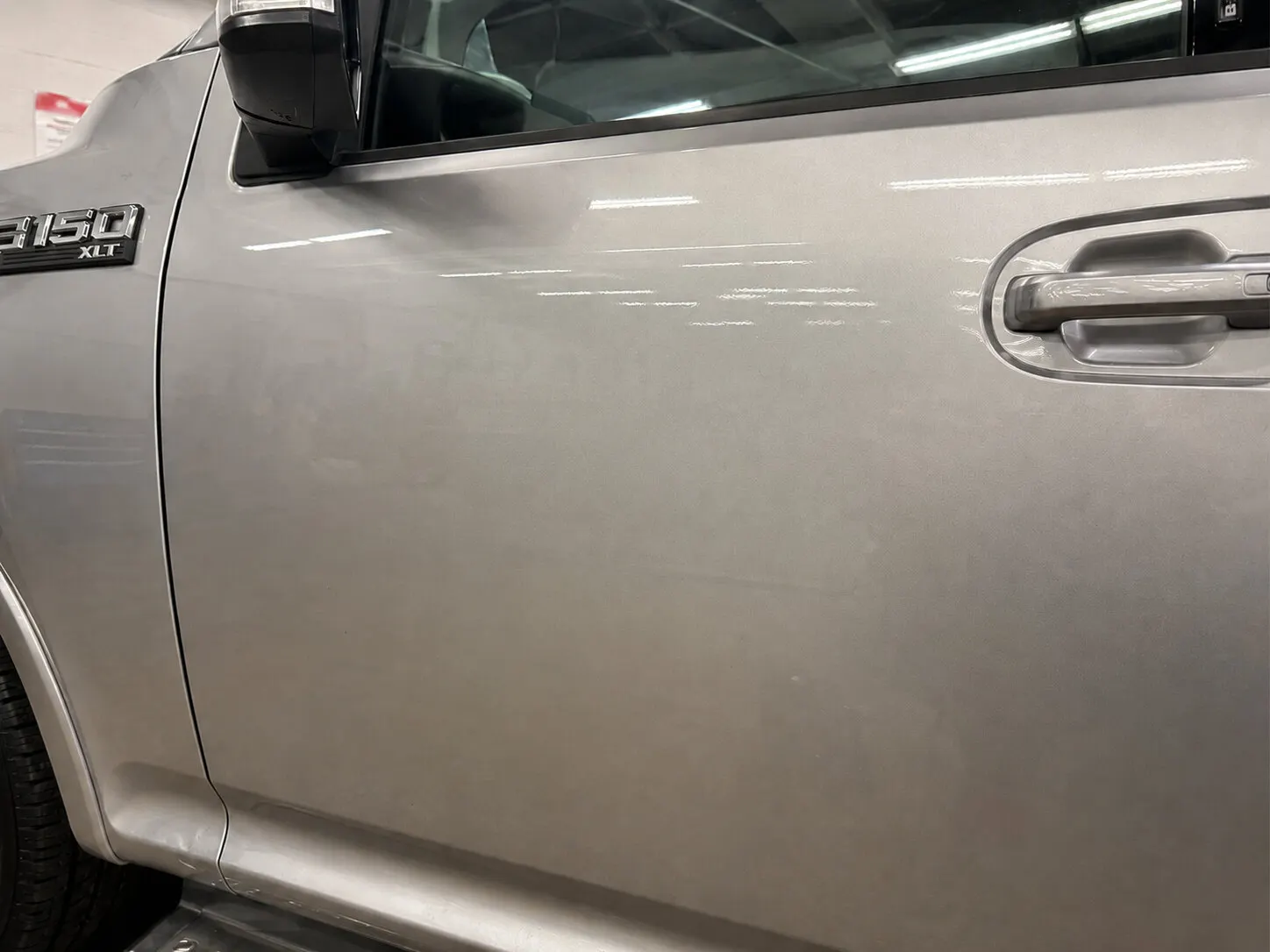
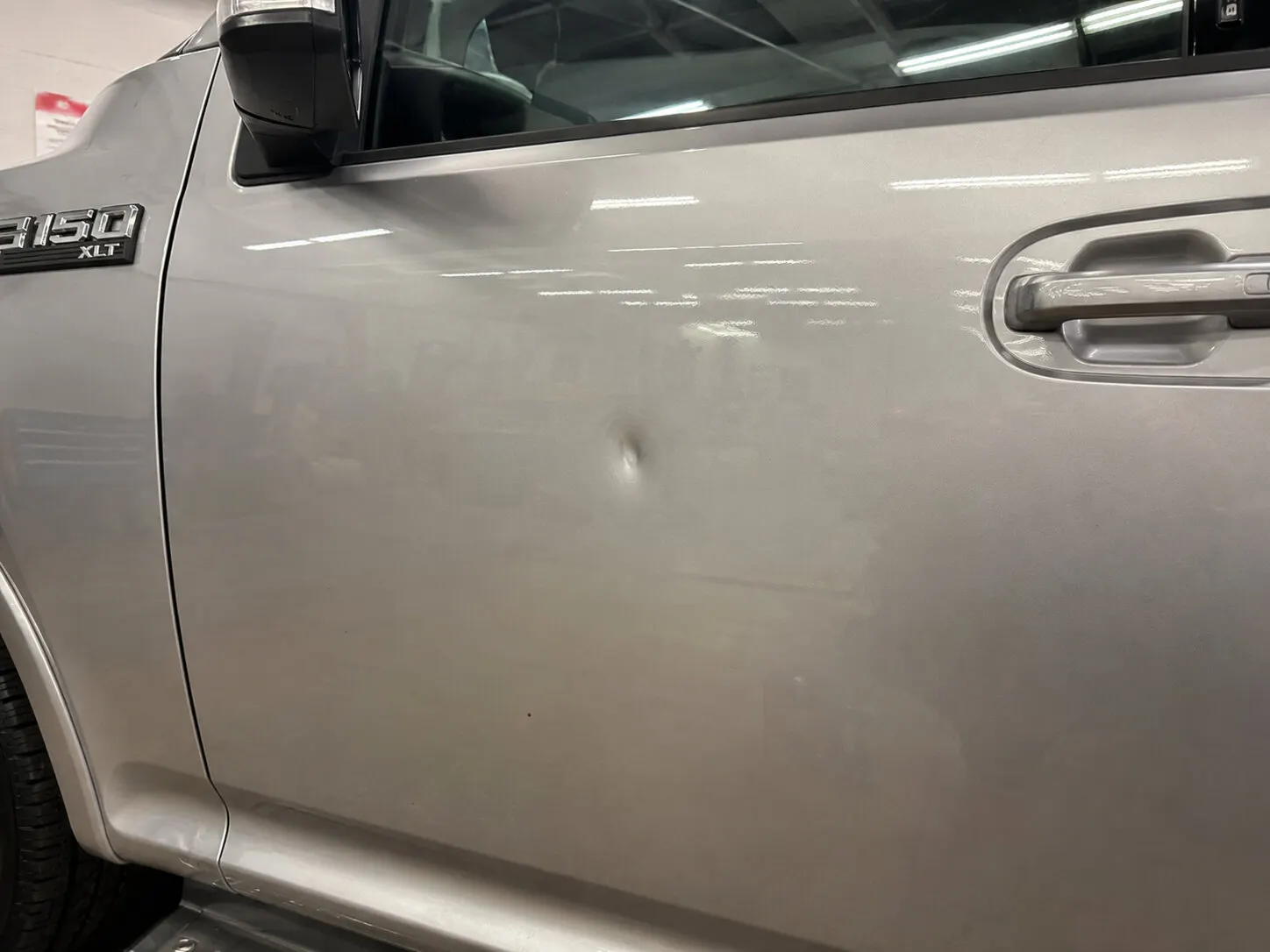
A crease on a door, worked out with the factory paint left alone. Drag to compare.
Questions, Answered.
What does a body shop cost beyond the quote?
Three to five days without the car, a rental, and a permanent line on the vehicle history that follows it to resale. Paintless dent repair on the same crease is usually an hour or two with the factory paint untouched. Most people weigh the invoice and never weigh the week.
Can paintless dent repair fix a sharp crease?
Yes, most sharp creases are repaired with PDR and never touch the paint. The metal along the crease is work hardened, so it has to be released in many small moves rather than one push, which takes an experienced hand. The repair holds as long as the finish is not already cracked and the back of the panel can be reached.
Will my car need to be repainted after a crease repair?
Not when the crease is a PDR candidate. The original factory paint stays on the car, so there is no filler, no color matching, no body shop record, and nothing on the Carfax. Repainting only enters the picture if the clearcoat already cracked along the fold or the metal was torn.
How much does it cost to fix a crease in San Diego?
A crease or body line dent runs $225 to $600 at Dent Time. A standard door ding on a flat panel is $197 to $250, and a medium dent is $275 to $500. Length, depth, panel location, and whether the panel is steel or aluminum decide where inside that range your repair lands.
How long does a crease repair take?
Most creases are same-day work, typically running one to three hours depending on length, depth, and access. A crease sitting on a body line takes longer because the sharp factory edge has to be rebuilt as well. The extra time is the repair being done in a way that protects your paint.
Does a crease on aluminum cost more than on steel?
Yes. Steel has memory and springs back toward its stamped shape, and a technician uses that. Aluminum has no memory at all, so it takes more force and more accuracy at the same time and carries a higher rate. On a Tesla Model 3 or Model Y, the hood and doors are aluminum while the front fenders are steel, so the same crease can price differently by panel.
How do I get a price for my crease?
Send a clear photo of the damage for a soft range, and we confirm the final number once we see the panel and what sits behind it. Text or call 858-408-6200, or bring it to the shop at 2120 W. Mission Rd #240 in Escondido. We reply within minutes during business hours.