Dry ice does not remove dents from car body panels. It cools the metal and the paint, and that is the full extent of what it does. If you are standing in your driveway holding a bag of dry ice and looking at a dent in your door, put the bag down and read this first.
The trick keeps circulating because the videos are convincing and the promise is irresistible. Five dollars of dry ice against a $300 repair. But the physics do not hold, and the version of this that goes wrong does not leave you where you started. It leaves you with stretched metal, a cracked clearcoat, or both. This is part of our myth-buster series on paintless dent repair, and it is the myth we get asked about the most.
Does dry ice actually pull a dent out of a car?
No. Dry ice cools a panel and nothing more, because a dent is stretched and displaced metal, not a temperature problem.
Understand what a dent actually is. When something hits a panel, the metal in that spot gets pushed past its elastic limit. It stretches, it displaces, and it locks into a new shape held there by tension from the metal all around it. That is a mechanical condition, not a thermal one.
Dry ice sits at roughly 109 degrees below zero Fahrenheit, and yes, cold metal contracts. But contraction pulls the entire panel evenly in every direction. It does not know where your dent is and it has no reason to unstretch that one spot. Cooling a panel is not a repair. It is a panel that is now cold.
The metal has to be physically moved back, from behind or with a controlled pull from the front, by someone reading the low spots in a reflection while they do it. There is no shortcut around that step, and there never has been.
Why does the dry ice trick look like it works on video?
Because most of those videos are filmed on flexible plastic bumper covers or on shallow flex dents that would have relaxed on their own anyway.
Watch the clips carefully and a pattern shows up. Almost all of them are on a plastic bumper cover, not on a painted steel or aluminum panel. Plastic behaves completely differently. It is flexible, it has a memory of its molded shape, and a shallow push in a bumper cover will often come back on a hot day in a parking lot with nobody touching it. Cool it, warm it, poke it from behind, and it pops. The dry ice was along for the ride.
The other category is the shallow flex dent in a large, unsupported area of thin sheet metal, the kind that oil-cans back and forth when you press it. Those sometimes release from almost any disturbance. Neither case is the dent in your door.
And a fair number of the clips are edited. Cut away, come back, dent is gone. That is a video, not a repair.
Myke works through the dry ice claim on the panel itself.
Can dry ice damage your paint?
Yes. Rapid extreme cooling makes clearcoat brittle and can crack the finish, and direct contact with dry ice will burn skin within seconds.
Automotive paint is a stack of layers with different rates of expansion sitting on top of metal that has its own rate. Drop that stack from a warm California panel temperature to well below zero in a matter of seconds and you are putting the whole system into thermal shock. Clearcoat gets brittle when it is that cold, and brittle finishes crack.
Now add the part people skip. If the paint has any existing chip, edge, or rock damage, that is where moisture goes and that is where the crack starts. And condensation forms the instant the panel warms back up, which means water sitting on any exposed metal you just made vulnerable.
There is a personal safety side too. Dry ice at that temperature causes tissue damage on contact within a few seconds, and it sublimates into carbon dioxide gas, which is a real problem in an enclosed garage. A repair method that requires ventilation planning and cryogenic gloves is not the low-effort option it was sold as.
What about hair dryers, boiling water, and compressed air?
They belong in the same category, because heat and cold can flex a plastic bumper cover back but they cannot unstretch a metal panel.
Every version of this myth follows the same shape. Heat the panel, cool the panel, hope the temperature swing does the work of a technician. Boiling water and a plunger. A hair dryer and a can of compressed air held upside down. A heat gun and a wet rag.
On a plastic bumper cover, heat genuinely helps, because heat lets plastic return toward the shape it was molded in. That is a real technique and it is used properly in bumper work. On a painted metal panel it does not transfer. Heat a steel door and you have a hot steel door with the same dent in it, and a heat gun held too long will haze or lift the finish.
It is not that people are foolish for trying. It is that the trick that works on one material got applied to a completely different one. And when the temperature tricks fail, the next purchase is usually a suction cup or a glue kit, which earns its own honest breakdown in do dent pullers actually work.
What actually removes a dent from a metal panel?
A trained technician reads the panel under reflected light, works the metal back from behind with rods or pulls it from the front with glue, and taps down the high spots until the reflection runs straight.
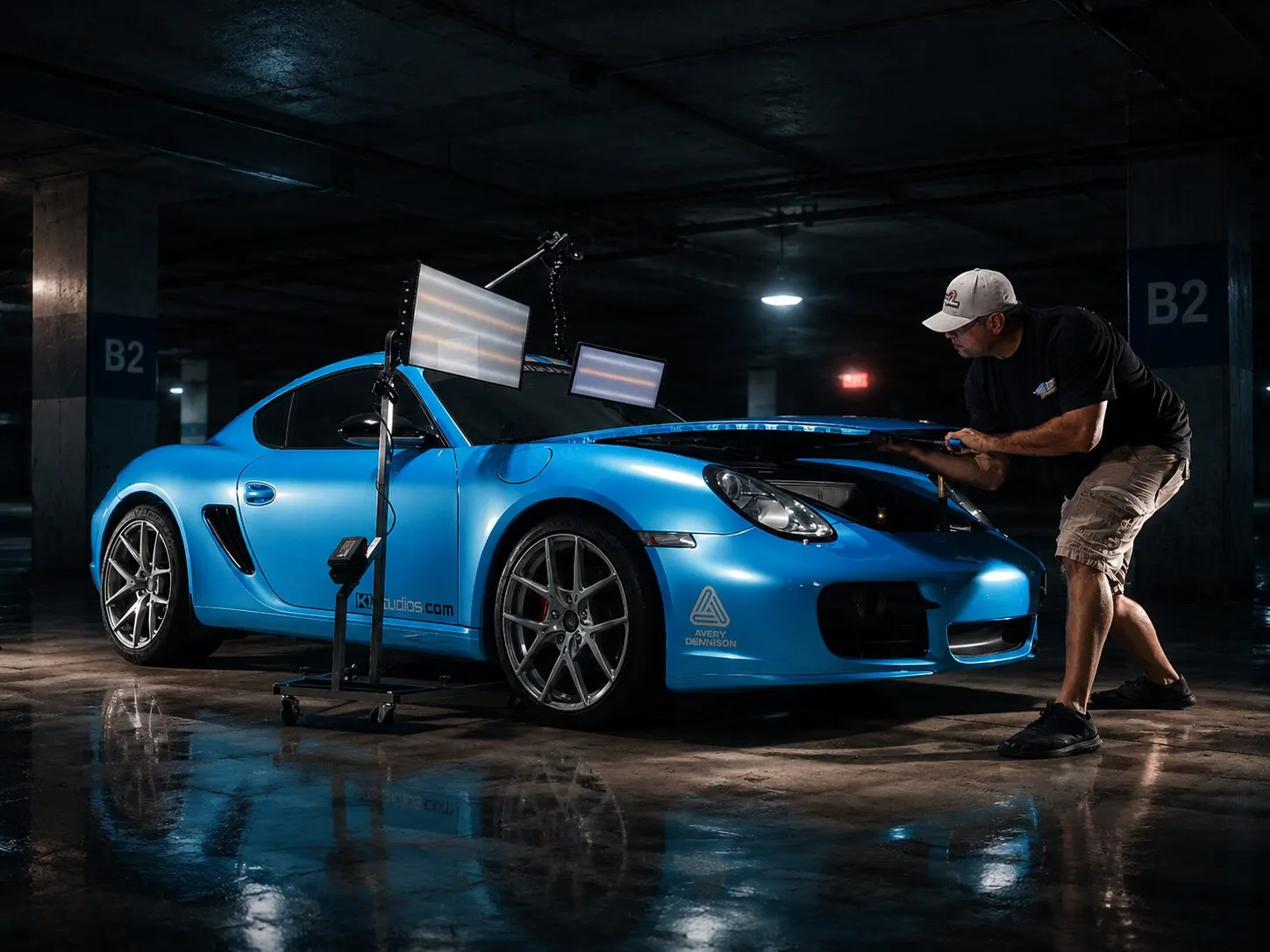
The real process starts with light, not with tools. A line board or a reflection board is placed so its straight lines run across the damage, and the technician reads how those lines bend to map every high and low in the panel. Sunlight cannot do this. Scattered daylight hides dents, which is exactly why yours looked worse the moment you pulled into a garage.
From there it is access. Sometimes a rod goes behind the panel through an existing opening, sometimes a trim piece or an interior panel comes out first, and sometimes the right move is glue pulling from the outside where there is no way in behind. The metal comes up in small increments, not in one heroic push.
Then comes the part almost nobody outside the trade knows about. Every push leaves a small high spot around it, and those get knocked back down with a tap-down tool, releasing the tension the dent was holding. Push, read, tap, read, push again. Repeat until the reflection runs through the panel without a bend. That loop is the craft, and no bag of dry ice performs a single step of it.
Tapping down the high spots. This is the step the myth has no answer for.
What does trying the shortcut actually cost you?
A failed home attempt can stretch the metal further, crack the clearcoat, or leave a crown, turning a $250 paintless repair into a body shop and repaint job.
Here is the math that the five-dollar bag hides. A door ding is $197 to $250. A medium dent is $275 to $500. A crease or a body line dent is $225 to $600. Those are the numbers when the panel is untouched and a technician gets it in original condition.
Now run a heat cycle, a cold shock, and a push from behind with a screwdriver and a rag on it. Best case, nothing happens and you paid for dry ice. Common case, the metal is stretched further and the repair now takes longer and costs more. Worst case, the clearcoat cracked and the panel needs paint, which means filler, color matching, a body shop invoice, and a permanent line on the vehicle history report. You went from keeping your factory finish to losing it.
We see the aftermath of DIY attempts regularly and we still fix most of them. But the honest version is this. The repair goes faster and takes less work when nobody has already worked the panel. Photos of what a rushed or amateur repair leaves behind are in our guide to bad paintless dent repair.
Who should be touching the panel?
Paintless dent repair has no licensing body, so the only real qualification is the technician's track record and the work you can inspect under a line board.
The dry ice myth survives partly because people do not know who to trust with a dent, so a DIY trick starts to feel safer than picking a stranger. That instinct is understandable, and it points at the actual issue.
PDR has no state license and no certifying board. No exam, no credential, no minimum hours. Anyone can order a rod kit and be advertising as a technician by the weekend. So the question is not whether paintless dent repair works. It does, and it has for decades. The question is whose hands are on your panel. It is not the repair you should be worried about. It is the technician performing it.
Myke has been doing this since 1991 and Dent Time has been open in San Diego County since 2001. Ask anyone quoting your car how long they have been doing this, ask what they will do if the paint cracks, and ask to see the finished panel under a line board before you pay. A technician who is confident in the work will hand you the light. What moves a price up or down is broken out in why PDR cost varies.
Questions, Answered.
What does a body shop cost beyond the quote?
Three to five days without the car, a rental, and a permanent line on the vehicle history that follows it to resale. Paintless dent repair on the same dent is usually an hour or two with the factory paint untouched. Most people weigh the invoice and never weigh the week.
Does dry ice really remove dents from a car?
No. Dry ice only cools the panel. A dent is stretched and displaced metal held in place by tension from the surrounding panel, which is a mechanical condition rather than a thermal one. Cooling contracts the whole panel evenly and has no way to target the damaged area.
Why do dry ice dent removal videos look like they work?
Most of those clips are filmed on flexible plastic bumper covers, which flex back toward their molded shape on their own. Others show shallow flex dents in large unsupported sheet metal that release from almost any disturbance, and a fair number are edited. None of them are the dent in your door.
Can dry ice crack my clearcoat?
It can. Dropping a warm panel to roughly 109 degrees below zero in seconds puts the paint layers into thermal shock, and clearcoat gets brittle at that temperature. Any existing chip or edge damage is where a crack starts. Once the finish cracks, the repair is no longer paintless.
Will a hair dryer or boiling water pop a dent out?
On a plastic bumper cover heat can help, because plastic returns toward its molded shape. On a painted steel or aluminum panel it does not work, because heat cannot unstretch metal. A heat gun held too long will also haze or lift the finish.
What actually removes a dent without repainting?
A technician reads the panel under a line board, accesses the metal from behind with rods or pulls it from the front with glue, then taps down the high spots to release the tension. That push, read, tap loop repeats until the reflection runs straight. The factory paint is never touched, so there is no filler, no repaint, and nothing on the Carfax.
I already tried it at home. Can you still fix it?
Usually, yes. We repair DIY attempts regularly. The honest answer is that a panel nobody has worked on is faster to bring back and takes less work, and if a home attempt cracked the finish, paint becomes part of the plan. Send a photo to 858-408-6200 and we will tell you where it stands.