
How In-Line Reflection Guides Dent Repair
At Dent Time, precision and artistry converge in the realm of Paintless Dent Repair (PDR). Our secret weapon? In-line reflection techniques that serve as the GPS for every intricate dent removal process. With over 33 years of experience, we’ve honed our methods to the point where reading the reflection patterns on a vehicle’s surface is second nature. This article delves into how in-line reflection is not just a technique but a vital tool for achieving flawless results in PDR.
How did the concept of using in-line reflection as a ‘GPS’ for dent repairs evolve in your practice?
Myke Toledo, the founder of Dent Time, explains that the concept of using in-line reflection as a guiding tool in PDR emerged out of necessity and innovation. Early in his career, Myke realized that traditional methods lacked the precision needed for flawless dent removal. By using specialized light boards, Myke and his team could visualize the surface’s contours in a way that no other technique allowed. This approach allowed them to map out each dent with unparalleled accuracy, leading to the adoption of in-line reflection as a core technique at Dent Time.
Can you share a particularly challenging case where the reflection patterns were difficult to interpret?
One of the most challenging cases Myke recalls involved a complex dent on a classic car’s curved panel. The reflection patterns were distorted in a way that made it difficult to discern the depth and direction of the dent. However, by meticulously adjusting the light board’s angle and using a variety of tools, Myke was able to interpret the subtle nuances in the reflection. This allowed him to execute precise pushes and taps, ultimately restoring the panel to its original form. This case highlighted the importance of experience and adaptability in reading reflection patterns.
When working with clients, how do you communicate the complexities and precision involved in reading and manipulating in-line reflections?
At Dent Time, we believe in educating our clients about the PDR process. We explain that in-line reflection is akin to a topographical map for the car’s surface. By showing clients the distorted lines before and after the repair, we illustrate the precision required to align the metal perfectly. This transparency not only helps clients appreciate the skill involved but also builds trust in our expertise. Our goal is to ensure clients understand the value of in-line reflection in delivering top-notch results.
Reflecting on past repairs, what are some key insights or lessons you have learned about the relationship between reflection patterns and successful dent removal?
Over the years, Myke has learned that patience and a keen eye for detail are crucial in interpreting reflection patterns. Every dent tells a story through its reflection, and it’s up to the technician to read and respond to those cues. Myke emphasizes that successful dent removal often depends on understanding how light interacts with the car’s surface. This understanding allows technicians to anticipate how the metal will react to each adjustment, ensuring a seamless repair.
What unique challenges does in-line reflection present that only a seasoned technician would recognize?
In-line reflection requires a level of expertise that distinguishes seasoned technicians from novices. One of the unique challenges is recognizing the subtle shifts in reflection patterns that indicate progress. A seasoned technician knows that these shifts can guide the repair process, even when the changes are barely perceptible. Additionally, experienced technicians understand how different lighting conditions can affect the reflection, requiring them to adjust their approach accordingly. This ability to adapt is what sets expert PDR work apart from shortcuts.
Real-World Example
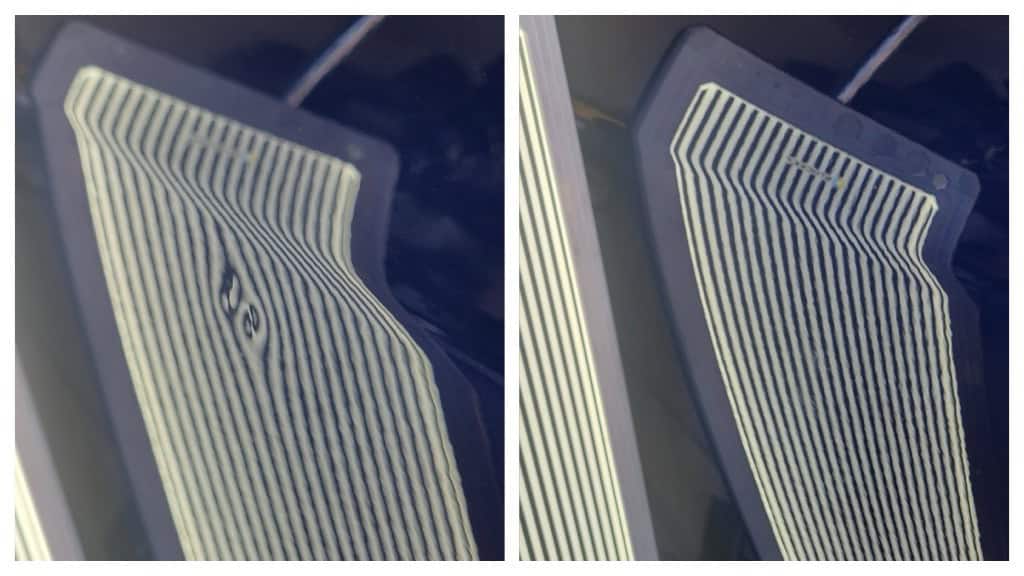
The provided photo captures a Dent Time technician using a PDR light board to assess a dent. The distorted lines in the reflection highlight the dent’s location and depth, allowing the technician to plan each adjustment precisely. As the technician works, the lines gradually realign, showcasing the progress of the repair. This real-time alignment of the lines is a testament to the effectiveness of in-line reflection as a guiding tool in PDR.
Experience the Dent Time Difference
At Dent Time, we pride ourselves on our expertise and dedication to excellence in PDR. If your vehicle has suffered a dent, trust us to restore it to perfection using our advanced in-line reflection techniques. We offer free estimates and welcome insurance claims. Call us at 858-408-6200 or visit our shop at 2120 W. Mission Rd. #240, Escondido, CA 92029. Explore our service area across San Diego County using our map link.
Frequently Asked Questions
What is in-line reflection, and why is it important in PDR?
In-line reflection refers to the use of specialized light boards that project straight lines onto a vehicle’s surface. These lines reflect off the surface, highlighting any deviations caused by dents. The importance of in-line reflection in PDR lies in its ability to provide a visual map of the dent, guiding technicians in making precise adjustments. By reading the reflection patterns, technicians can restore the metal to its original form without using paint or fillers.
How long does it take to master the skill of reading in-line reflections?
Mastering the skill of reading in-line reflections requires years of dedicated practice and experience. Technicians must develop a keen eye for detail and an understanding of how light interacts with different surfaces. At Dent Time, our technicians undergo extensive training to hone their skills, ensuring they can interpret reflection patterns accurately and execute flawless repairs. This expertise is what sets our PDR services apart, providing clients with exceptional results.
Can in-line reflection be used on all types of dents and surfaces?
In-line reflection is a versatile technique that can be used on a wide range of dents and surfaces. Whether dealing with minor door dings or larger, more complex dents, in-line reflection provides the precision needed for effective PDR. However, the technique does require a controlled lighting environment to ensure accurate readings. At Dent Time, our state-of-the-art facilities and experienced technicians enable us to use in-line reflection effectively on various surfaces, ensuring optimal results for every repair.